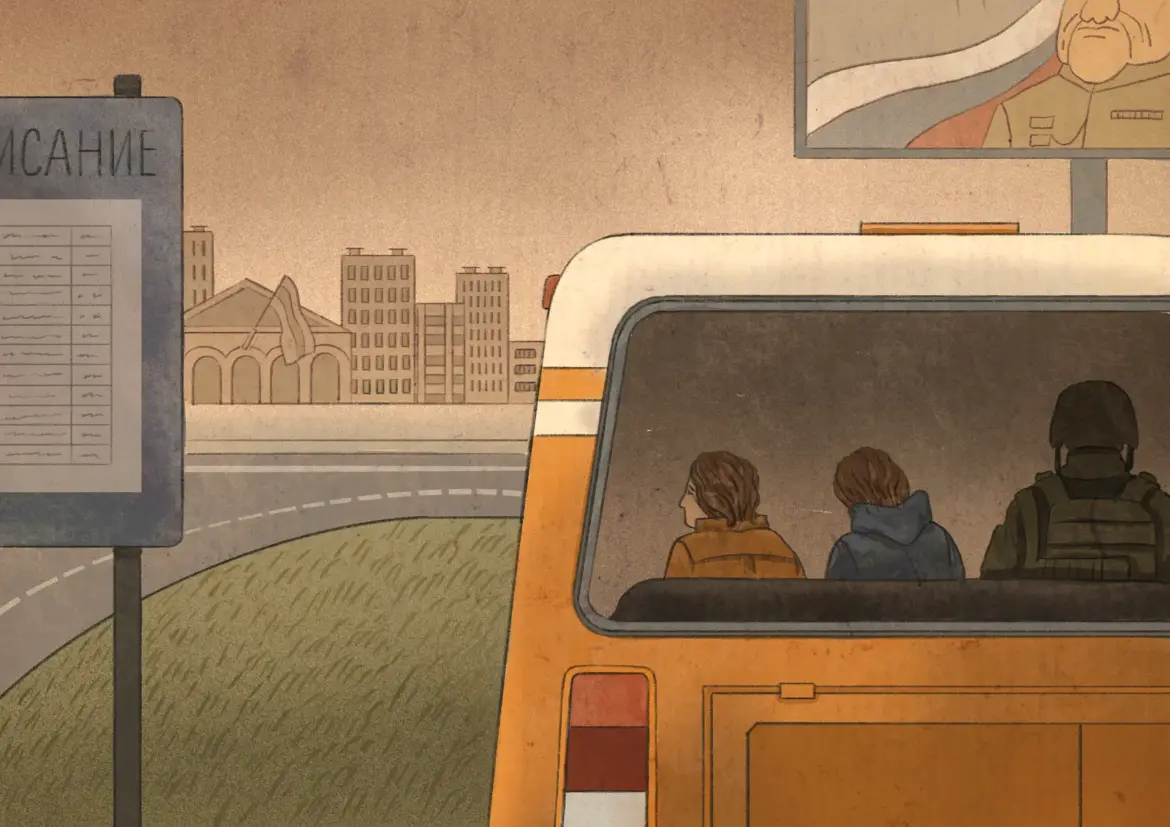
Brothers Davyd and Anton grew up under occupation in eastern Ukraine. The boys completed first grade at a Ukrainian school before their city began to be transformed into what was effectively a Russian province. The young men say that before the full-scale invasion, the occupying authorities deliberately created a humanitarian crisis, closing shops, schools and businesses. On 23 February 2022, the boys, their mother, sisters and grandmother were evacuated to Russia. The brothers spent five years struggling to survive in various temporary shelters across the aggressor country. They were pressured to renounce their identity, subjected to humiliation and threatened with forced conscription into the Russian army. Ukrainian volunteers helped the brothers leave Russia. They travelled alongside older people from the occupied territories.
(The names of the individuals have been changed for security reasons.)
“Everyone was being evacuated because there was practically no food left, and no drinking water either. We had lost the keys to our apartment shortly before that and wanted to have a duplicate made. But the locksmith shops were closed. When we left, we pulled the door shut, and that was it,” recalls 20-year-old Davyd.
It was 23 February 2022. Convoys of buses were lined up in the centre of Makiivka, Donetsk Region. The Russian State had announced a full evacuation and were taking children from orphanages. Explosions could not yet be heard in the city, but living conditions had already become appalling. Shops were closing, and schools run by the occupying authorities were no longer operating. Young men were being mobilized into the Russian army on the streets by the so-called “DPR” quasi-state armed groups.
Davyd and Anton boarded Russian buses with their mother and younger sisters, which took them somewhere to the east. They say they had no idea what awaited them or where they were being taken. They no longer had any way of returning to Ukraine. Instead, they were forced to move between temporary shelters in Russia, including children’s camps, rural houses and dormitory rooms. Anton recalls that some of the buildings were in terrible condition, with foul smells and peeling walls. In March 2023, the boys enrolled in a Russian village school. Davyd entered the tenth grade, while Kyrylo entered the seventh.
“On our second day, our classmates asked when we were going to get out of Russia. They said all their problems were because of us. In general, they blamed us for starting the war. They also mocked us and asked us to pronounce the Ukrainian letter ‘ґ’’ says 18-year-old Anton.
[The Ukrainian letter “ґ” represents the hard “g” sound, while “г” is pronounced like “h”. Ukrainians sometimes carry this pronunciation into Russian, making their Ukrainian accent noticeable and a target of mockery.]
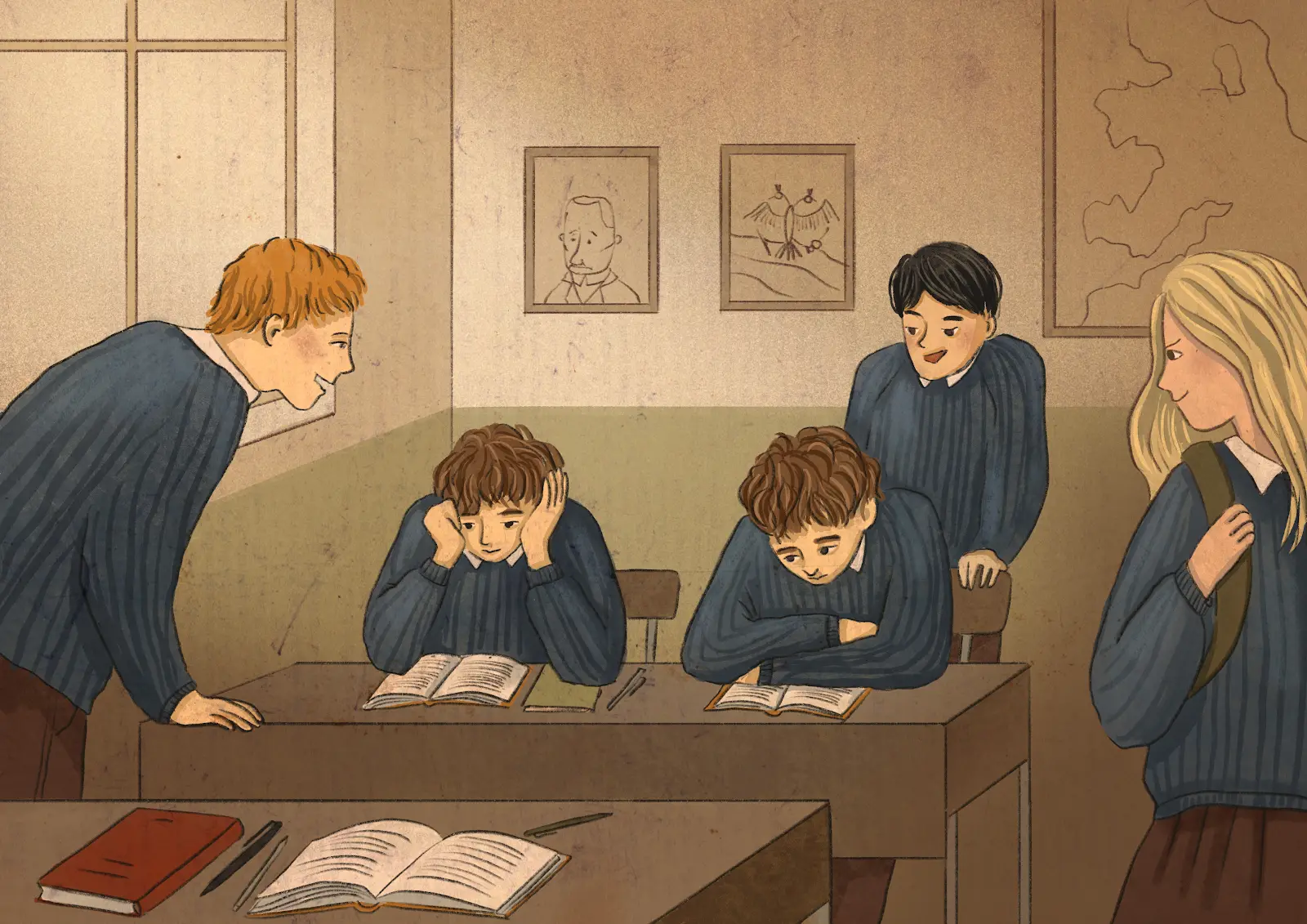 The young men had hoped they would not be in Russia for long. Their mother reassured them that they just needed to wait for the war to die down and then they would be able to return. But by 2023, the boys had already started saving money, hoping they would soon be able to leave Russia behind. They looked for various ways to earn extra income. However, at the end of 2023, their grandmother died unexpectedly. They had to spend all their savings on her funeral. The boys were forced to continue their education.
“We changed schools frequently. I remember studying at one school far from the city. The building probably dated back to the 19th century. It had cadet classes. The cadets marched around wearing military uniforms. My brother and I refused to become cadets, but we only studied there for two months anyway. Then we moved to another temporary accommodation facility,” says 18-year-old Anton.
During their time in Russia, the Ukrainian brothers lived in several cities and attended several schools. They admit that every lesson filled with propaganda further eroded their desire to study.
“During the ‘Conversations About Important Things’ lessons, students were told about Russia’s resources and how powerful the country was. But they kept quiet about the fact that a large part of the population was actually living on the brink of poverty. And some schools were practically falling apart. Teachers who earned very little themselves lied about how mighty Russia was and how they were liberating their lands from neo-Nazis,” Anton says indignantly.
Every Monday, students were required to sing the Russian national anthem. They also had to participate in patriotic celebrations, including Victory Day on 9 May. Davyd and Anton did not consider themselves Russian. They refused to sing the Russian anthem and frequently missed school.
“Almost every month, our mother was summoned to the school and asked why we were missing so many classes and why our grades were so poor. I never once opened their history textbook. I already knew it had been rewritten. And in general, I lost all desire to study,” Anton admits candidly.
After completing the ninth grade, the older brother, 20-year-old Davyd, enrolled in a Russian vocational college. He hoped this would mean he would not have to register for military service and could continue avoiding mobilization. By then, he had already turned 18. Davyd chose to train as a cook. His Russian peers humiliated him, while the instructors largely ignored the bullying. They knew he was a refugee from Ukraine.
“The instructor responsible for our group treated me with contempt. They deliberately gave me lower grades because they knew I was Ukrainian. I transferred to another program to train as an electrician. The attitude there was slightly better, but I found studying difficult,” Davyd says.
FSB Search and Mobilization
The Ukrainian young men concealed their pro-Ukrainian views. They knew Russia was not their homeland, having studied Ukrainian from first grade until the occupying authorities banned the language altogether. The brothers made no friends in Russia and did not tell anyone about their lives. They say that on one occasion, while staying in a dormitory, they were warned that a police officer would come to speak with them. Instead, FSB officers arrived, confiscated their phones and conducted a search.
“They took our phones for 20 minutes and spent a long time checking something on them. Most likely, they installed tracking and surveillance software,” Davyd adds.
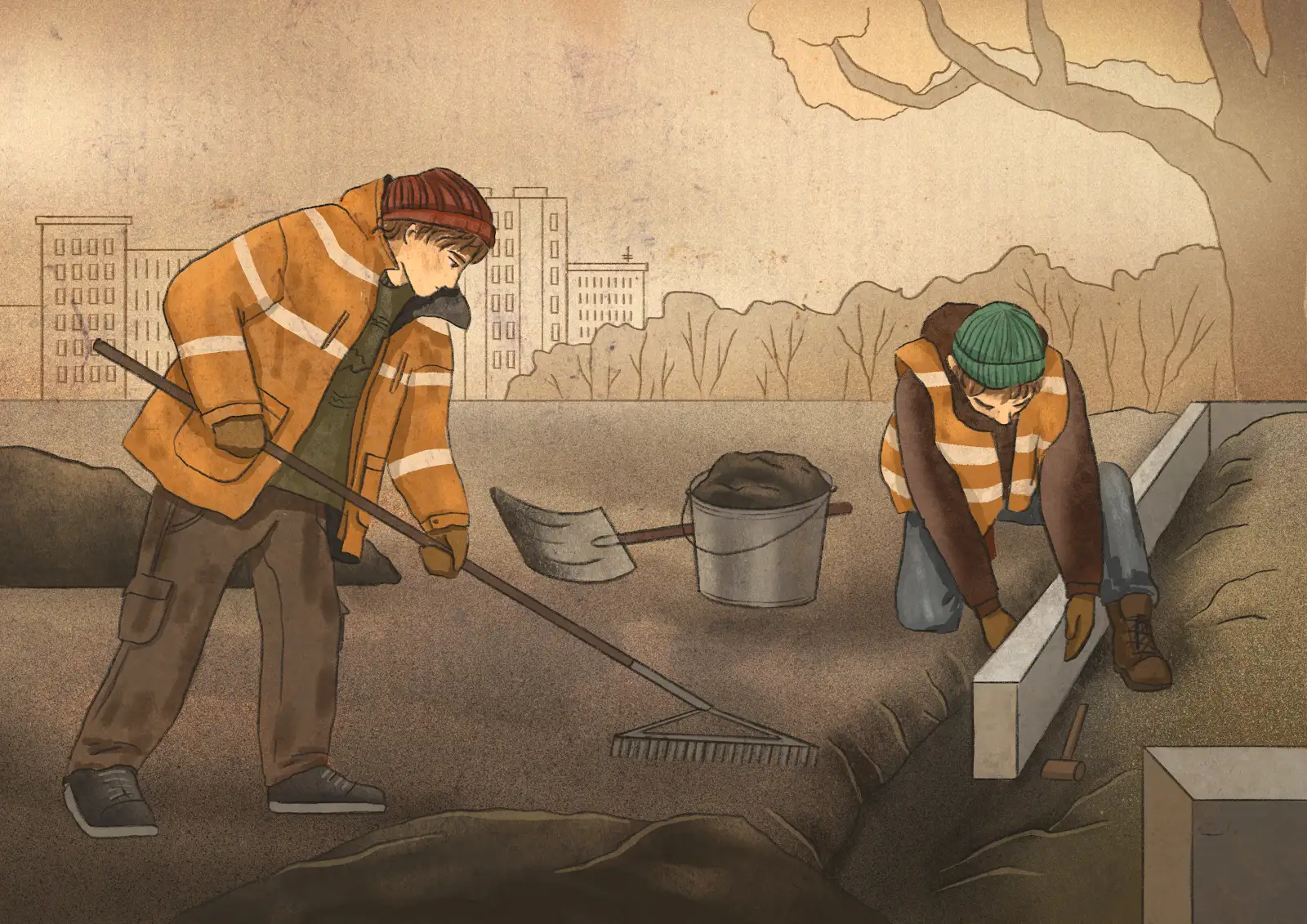
During the summer, the boys travelled to the Moscow Region to earn extra money doing road construction work. They carried asphalt, crushed stone and other construction materials. Once again, they planned to save the money to leave Russia. They say their mother earned very little at her job, barely enough to buy bread. In January 2026, Davyd was told at his temporary accommodation facility that he needed to replace his passport. He went to a document processing center, where he received a referral from the military enlistment office for a medical examination. Davyd suspected that he might soon be mobilized and sent to war. He had heard that many members of ethnic minorities holding Russian passports were being sent to fight.
 “I underwent the medical examination and was assigned fitness category B1. That means I was fit for military service. Then they issued me a summons to report to the military enlistment office on 27 February 2026. I didn’t go. I didn’t leave the place where I was staying at all,” Davyd says.
The brothers contacted volunteers who help Ukrainians leave Russian-occupied territories. The volunteers agreed to help, bought the boys tickets to Belarus and explained the plan for their departure. In early March, the brothers left the Russian Federation on their own.
“Once we were in Belarus, we met the volunteers. They were also helping two older people, aged 81 and 63, leave the occupied territories. We helped them load their belongings into the car. We all got in and headed towards the Ukrainian border. On the way, the 81-year-old man suddenly died. He never got to see the Ukrainian border,” Anton recalls.
Forced evacuation and deportation are illegal.
According to a report by the Independent International Commission of Inquiry published on 12 March 2026, Russian authorities deported or transferred thousands of children from the occupied territories of Ukraine. The Commission has so far confirmed the deportation or transfer of 1,205 children. Russian authorities described these large-scale transfers as “evacuations”, justifying them on the grounds of risks associated with the armed conflict.
At the same time, international humanitarian law stipulates that evacuations of children to another country must be temporary and may only be carried out for compelling reasons related to the children’s health, medical treatment or safety. Evacuations for any other reasons are prohibited. Four years have passed, yet 80 percent of the children deported or transferred in the cases investigated by the Commission have still not returned. Russian authorities have not established a system to facilitate their return. Instead, they have focused on placing children in families or institutional facilities in the Russian Federation on a long-term basis.
The brothers quickly began adapting to their new lives in Government-controlled territory of Ukraine. They say that although the constant air raid alerts and attacks are frightening, living in Russia was even harder. They have started working and plan to enrol in Ukrainian universities. Their mother and sisters have also recently left Russia.
Author: Lesia Kesarchuk, artwork: Mar’iana Mikitiuk
The text was created in collaboration with The Reckoning Project, a global team of journalists and lawyers documenting, publicising, and building cases of atrocity crimes.